When you’re starting a business, choosing the technology for your website can feel like a difficult decision.
There are many platforms and technologies available today. You can build a website with a website builder, use a fully custom development approach, or choose a content management system such as WordPress.
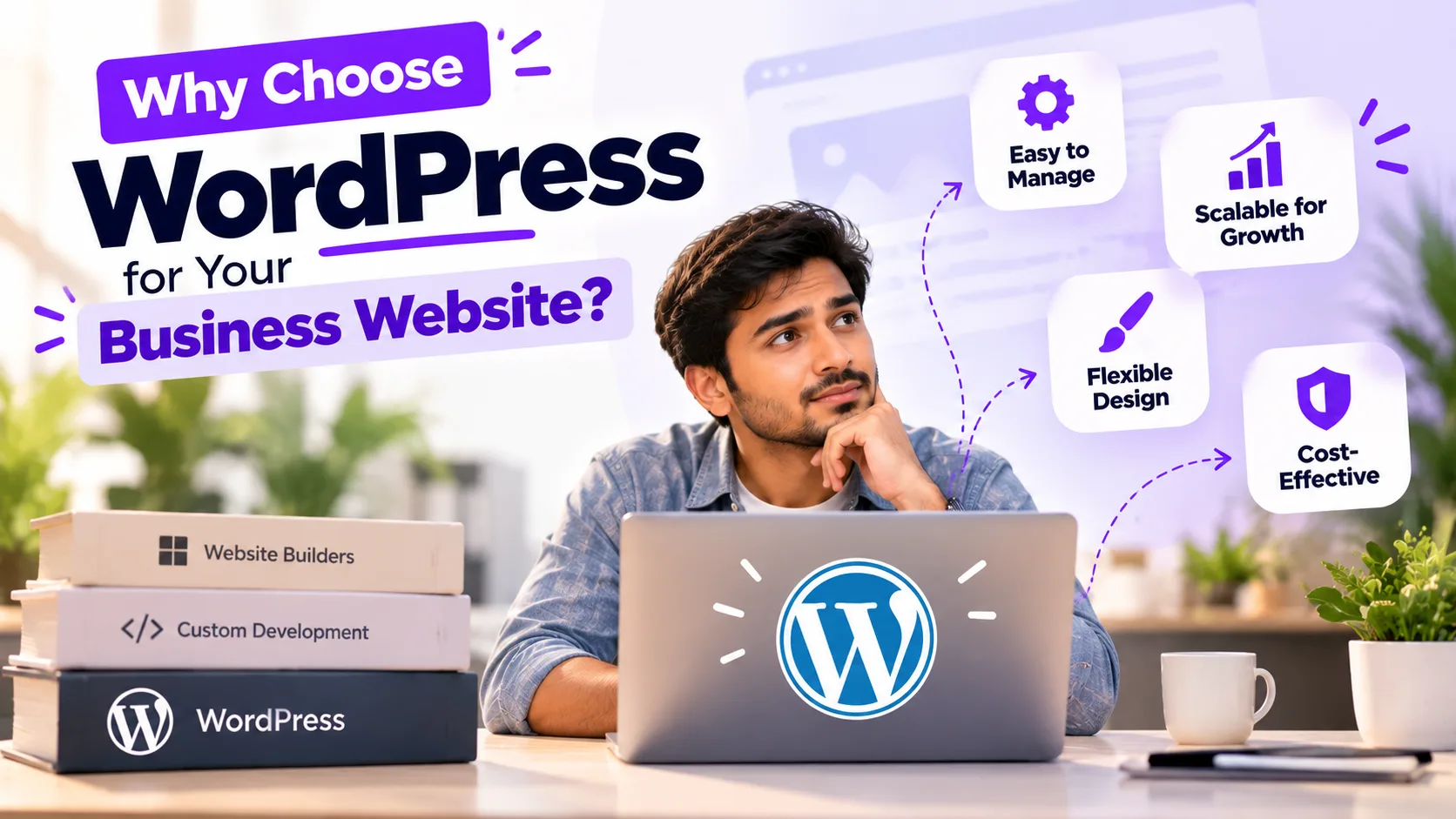
From my experience working with business websites, WordPress is one of the most practical choices for businesses that want flexibility, easy content management, SEO capabilities, and the freedom to grow their website over time.
1. You Can Easily Manage Your Website Content
One of the biggest reasons to choose WordPress is simple: you can manage your own content.
A business website is rarely finished forever.
You may need to:
- Add a new service
- Update existing content
- Publish a blog post
- Add a new case study
- Update your team members
- Change images
- Create a landing page
- Add a new project to your portfolio
- Publish company news
With WordPress, these types of changes can be managed through the dashboard without rebuilding the entire website.
For a business owner, this can make a huge difference.
You don’t want to contact a developer every time you need to change two lines of text or publish a new case study.
2. WordPress Is Excellent for Content Management
WordPress started as a publishing platform, and content management remains one of its biggest strengths.
Imagine you run a design or development agency.
Over time, you might want to publish:
- Blog articles
- Case studies
- Client projects
- Testimonials
- Team members
- Services
- Industry insights
- Guides and resources
Instead of treating every piece of content as a completely separate custom page, WordPress allows you to create structured content that can be managed from the dashboard.
For businesses that regularly publish content, this makes the website much easier to maintain.
3. It’s a Strong Platform for SEO
SEO is another major reason many businesses choose WordPress.
Of course, simply using WordPress does not guarantee Google rankings.
Good SEO still depends on strategy, high-quality content, technical SEO, website performance, backlinks, user experience, and many other factors.
But WordPress provides a strong foundation for SEO.
You have control over your website structure, content, metadata, URLs, headings, images, internal linking, and many other elements.
There are also mature SEO tools and plugins available that can help businesses manage their optimization.
Compared with building everything from scratch, WordPress can allow a business to get a well-structured, SEO-ready website developed more efficiently.
4. You Can Build a Professional Website Without Building Everything From Scratch
Another major advantage is the WordPress ecosystem.
You don’t have to reinvent every feature.
Depending on the project, you can use WordPress with tools such as:
- Gutenberg / the WordPress block editor
- Elementor
- Divi
- Other page builders
- Custom themes
- Custom plugins
- Existing integrations
This gives businesses different levels of control.
If you want a simple website that your team can edit visually, a page builder can make that possible.
If you need a highly customized website, developers can build custom functionality on top of WordPress.
That flexibility is one of the reasons WordPress works for businesses of very different sizes.
5. You Have the Freedom to Build Almost Anything
One of the biggest advantages I’ve seen with WordPress is its flexibility.
You aren’t limited to creating only a basic five-page website.
You can build:
Business websites → Blogs → Portfolios → Case study platforms → E-commerce stores → Membership websites → Booking websites → Custom business platforms
And you can combine different features depending on what the business needs.
For example, a company might start with a simple corporate website.
Later, it may want to add an online store.
After that, it might want customer accounts, a resource library, advanced forms, marketing automation, or integrations with other business systems.
WordPress gives you room to keep building.
6. You Can Start Small and Expand Later
This is particularly important for startups and growing businesses.
You don’t necessarily need to spend a huge amount of money building every possible feature on day one.
You can start with the essentials:
- Home
- About
- Services
- Portfolio or case studies
- Blog
- Contact
Then, as the business grows, you can add more functionality.
This makes WordPress a practical option when you don’t know exactly what your website will need in the future.
Build what you need today. Keep the flexibility to build what you need tomorrow.
7. It Can Be More Cost-Effective
Budget is an important consideration for almost every business.
A completely custom website can be the right choice for certain projects, but it can also require significantly more development time and investment.
WordPress provides an existing foundation, which means developers don’t have to build the entire content management system from zero.
That can reduce development time and make it possible to allocate the budget toward the things that actually make the website valuable — such as design, content, performance, SEO, integrations, and custom functionality.
WordPress can also be hosted across a wide range of hosting providers, giving businesses more choices when it comes to hosting costs and infrastructure.
8. You Have More Freedom to Choose Who Works on Your Website
Another benefit that is often overlooked is flexibility when working with developers or agencies.
Your business shouldn’t necessarily be locked into one person or one agency forever.
If your website is built properly using WordPress, another experienced WordPress developer or agency can generally take over the project and continue working on it.
That gives businesses more freedom.
You can work with one agency for the initial website, another specialist for SEO, and potentially another developer later for a specific project.
The website remains a business asset rather than something that exists only inside one developer’s system.
9. You Can Edit the Website Yourself
With tools such as Gutenberg, Elementor, Divi, and other WordPress editing solutions, businesses can have different levels of control over their website.
Depending on how the website is built, you may be able to visually edit pages, move sections, update text, change images, create new pages, and make other changes without writing code.
This is especially useful for businesses that want their website team to be involved in day-to-day updates.
The key is that the website should be built properly in the first place.
A drag-and-drop editor is useful, but good website architecture, performance, accessibility, responsive design, and maintainability still matter.
10. WordPress Has a Huge Ecosystem
WordPress is not a small or isolated platform.
It powers a very large portion of the web and has an enormous ecosystem of developers, agencies, hosting companies, plugins, themes, integrations, and tools.
That ecosystem matters.
When your business grows, you have access to a large pool of expertise and solutions.
You aren’t relying on a single developer to have invented a completely unique system that nobody else understands.
There is an established technology and community behind the platform.
11. Security Can Be Managed With a Mature Ecosystem
Security is important for every business website.
No website platform is automatically secure, and WordPress is no exception.
However, WordPress has a mature ecosystem around security, updates, backups, hosting, monitoring, authentication, and security plugins.
A properly maintained WordPress website can be secure and reliable.
The important part is responsible website management:
Keep WordPress updated. Keep plugins and themes updated. Use trusted software. Use secure hosting. Maintain backups. Follow good security practices.
The platform is only one part of website security.
12. WordPress Gives Your Business Long-Term Flexibility
Perhaps the biggest reason to choose WordPress is not one specific feature.
It’s the flexibility.
Your business may look completely different three years from now.
You might expand your services, enter a new market, launch an online store, publish more content, create a resource centre, or introduce new ways for customers to interact with your business.
Your website should be able to evolve with you.
That’s where WordPress can be particularly valuable.
Is WordPress the Right Choice for Everyone?
No.
And that’s an important point.
I wouldn’t recommend WordPress simply because it is popular.
The right technology depends on the business, its requirements, budget, internal team, performance needs, integrations, and long-term plans.
Some projects may benefit from a custom-built application. Others may be better suited to another platform.
The goal should always be to choose the technology that makes the most sense for the business.
Why I Recommend WordPress for Many Businesses
From my experience, the biggest advantage of WordPress is the combination of several things:
Easy content management.
Strong SEO foundations.
Flexible design options.
Large ecosystem.
Lower development barriers.
Extensibility.
Content publishing.
Business integrations.
Long-term flexibility.
You don’t have to choose between a simple website and a website that can grow.
With the right approach, you can start with a focused business website and continue building on the same platform as your requirements become more advanced.
Final Thoughts
Choosing a website platform is really about choosing the foundation for your digital presence.
For many businesses, WordPress offers a practical way to build that foundation without sacrificing flexibility.
You can start small, manage your content, publish articles and case studies, improve your SEO, connect business tools, add new functionality, and continue developing the website as your business grows.
Your website should not just work for your business today. It should give you the freedom to build for tomorrow.
That’s the main reason WordPress remains a platform worth considering for a business website.